Skip to content

Page 55 of 144

Search Results

  • When People Don't Trust Algorithms

    Even when faced with evidence that an algorithm will deliver better results than human judgment, we consistently choose to follow our own minds. Why? MIT Sloan Management Review editor in chief Paul Michelman sat down with the University of Chicago’s Berkeley Dietvorst to find out.

    Learn More »
  • The End of Corporate Culture As We Know It

    We are evolving toward an age of networked enterprises, in which the traditional hierarchies of the corporation will be supplanted by self-organizing systems collaborating on digital platforms.

    Learn More »
  • Leading to Become Obsolete

    Zhang Ruimin, the CEO and chairman of the Qingdao, China, white goods giant Haier Group Corp., has done what most chief executives dare not even dream about. He blew up nearly the entire administrative structure of a global manufacturing enterprise, eliminating the 10,000 management jobs that once held it together. And he has guided the organization to re-form as a network of entrepreneurial ventures run by employees.

    Learn More »
  • Don't Give Up on Corporate Culture

    MIT Sloan Management Review editor in chief Paul Michelman argues that the importance of corporate culture will dissipate as organizations become flatter and more distributed. However, several readers take a different view.

    Learn More »
  • Mastering the Make-In-India Challenge

    Despite India’s economic growth, many foreign companies have found it difficult to make money selling there. But a number of companies have found a winning strategy that involves weaving together local and global value chains.

    Learn More »
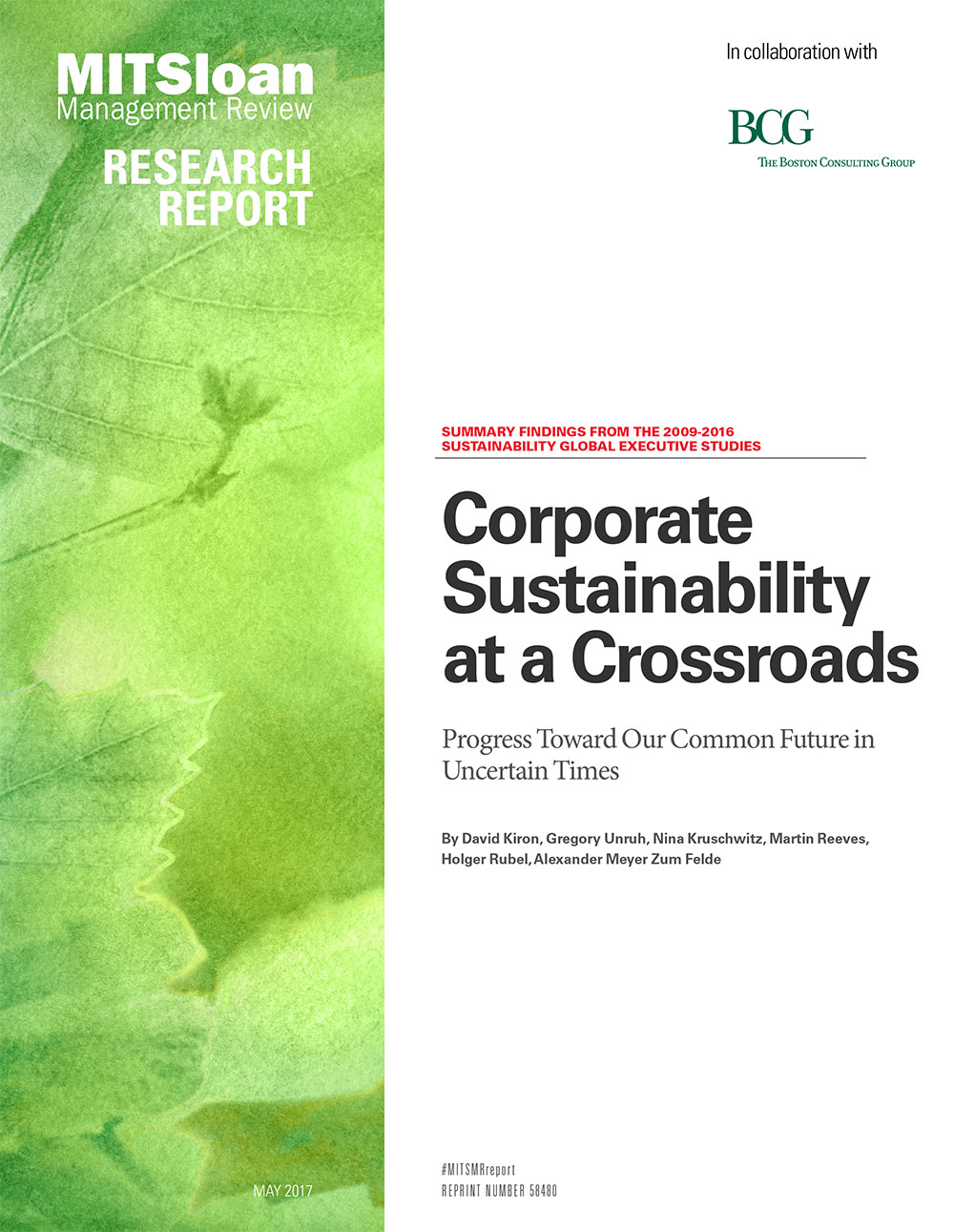
  • Corporate Sustainability at a Crossroads

    In the final report of our 8-year study of how corporations address sustainability, MIT Sloan Management Review and The Boston Consulting Group examine the crossroads at which sustainability now finds itself. Despite sociopolitical upheaval that threatens to reverse key gains, our research has shown that companies can develop workable — and profitable — sustainability strategies to reduce their impact on the global environment by incorporating 8 key lessons.

    Learn More »
  • What You Need to Know Before Starting a Platform Business

    There’s a great deal of enthusiasm about platform strategies these days. Entrepreneurs pitch their startups as the next Uber, the next Facebook, or the next Airbnb, while executives in established companies are retooling their strategies around platforms to drive growth and compete digitally. But creating a successful platform business is not easy — as economists Richard Schmalensee and David S. Evans explain in this MIT Sloan Management Review interview.

    Learn More »
  • Harnessing the Secret Structure of Innovation

    Innovation, much like marketing and human resources, can be made less reliant on artful intuition by using information in new ways. But this requires a change in perspective: We need to view innovation not as the product of luck or extraordinary vision but as the result of a deliberate search process.

    Learn More »
  • The Big Squeeze: How Compression Threatens Old Industries

    Accelerating compression of both revenues and profits may rapidly prove fatal to traditional businesses. Consider the accelerating decline of voice calls as a means of communicating via mobile telephone: From 2013 to 2015, average mobile voice revenue per user declined globally by 19%, and a further decline of 26% is expected through 2020. To stave off disaster, incumbents must transform and renew their core operations — while also growing into new businesses and industries.

    Learn More »
  • Building a More Intelligent Enterprise

    The authors examine how managers can combine a sophisticated understanding of human decision making with technology-enabled insights to make smarter choices in the face of uncertainty and complexity. Integrating the two streams of knowledge is not easy, but once management teams learn how to blend them, the advantages can be substantial.

    Learn More »