Skip to content

Page 26 of 85

Search Results

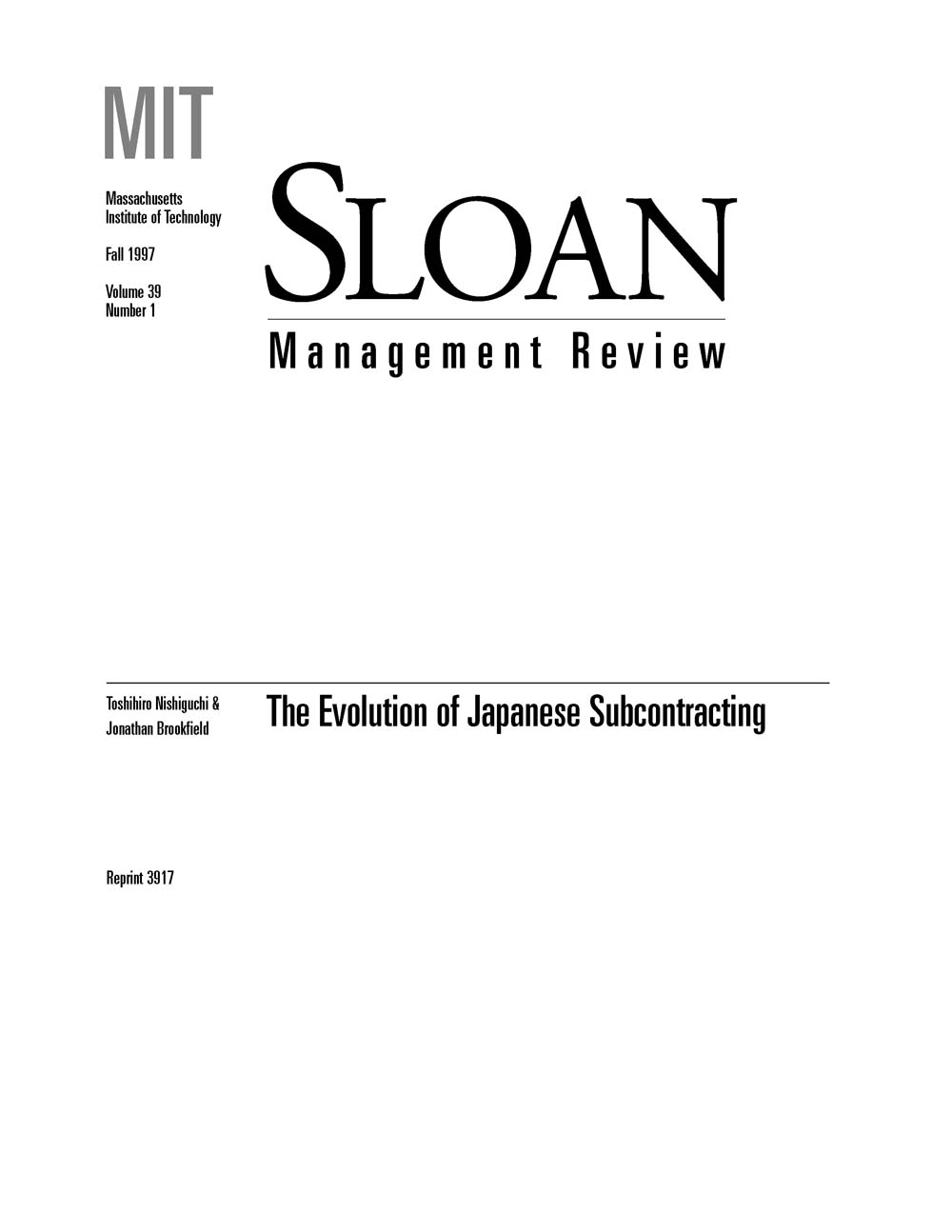
  • The Evolution of Japanese Subcontracting

    The authors trace the development of Japanese subcontracting from just after World War I when the labor market in Japan divided into two areas: large firms, especially heavy industries, and the rest of the economy. During World War II, the demand for munitions, cheap labor, changes in infrastructure and technology, and politics led to the further development of subcontracting. After the war, government protections aided its continued growth, until a major transformation in the 1960s during Japan's high-growth economy. The modern form of Japanese subcontracting relies on distinct practices that have developed around the system of clustered control and joint problem solving: -- Target costing. Japanese manufacturers lower costs of new products at the design stage by first determining the sale price, decomposing the price into desired profit and costs, and then breaking down costs to evaluate and price every part. Throughout the process, suppliers provide input. -- Value analysis. In joint problem-solving with prime contractors and subcontractors, Japanese manufacturers decompose increasingly complex cost structures to identify cost-sensitive elements item by item. -- Bilateral design. Modularization, which leads to cost reductions and ease of design changes, results from suppliers' proposals. -- Subcontractor evaluation. The prime contractor continually evaluates subcontractors' performance on quality, price, delivery, engineering, management competence, and long-term viability. -- Purchasing agents' role. Purchasing agents are not mere negotiators but have the technical knowledge to evaluate subcontractors' competence and teach them new production systems. Nishiguchi and Brookfield address several prevalent theories for the evolution and growth of Japanese subcontracting: dualism, flexible specialization, transaction cost economics, and cultural specificity. In their view, no single theory can fully explain the growth of subcontracting. Instead, they posit, it is the product of interaction among market demand, politics, technology, and producer strategy.

    Learn More »
  • Spring 2026

    Our spring 2026 issue features a special report for strengthening your company’s strategic innovation capabilities. We also focus on how to build employees’ digital skills, managing supply chain risk, running a real-time business, and more.

    Learn More »
  • Leading for Maximum Productivity

    How can organizations increase productivity and value creation? Research shows that leaders who are most successful pay close attention to creating healthy and open cultures.

    Learn More »
  • How to Help High Achievers Overcome Imposter Syndrome

    Managers can help employees turn fears into fleeting thoughts as opposed to permanent restraints.

    Learn More »
  • The Ends Game

    How some firms are rewriting the rules of commerce by pursuing “ends”—actual outcomes—rather than selling “means”—their products and services.

    Learn More »
  • Overcoming the Innovator’s Paradox

    Innovators need to develop their innovation capital so they can turn their ideas into reality.

    Learn More »
  • Using AI to Enhance Business Operations

    Five capabilities and four practices help companies generate business value from AI applications.

    Learn More »
  • The Inside and Outside View of Innovation

    Two recent books focus on different aspects of innovation — within and outside the organization.

    Learn More »
  • How Cisco's Learning Network Became a Social Hub for the IT Industry

    Cisco's social educational platform, Learning@Cisco, is a key hub for people in IT around the globe.

    Learn More »
  • How to Change an Organization Without Blowing It Up

    Mining the middle ground between wholesale change and pilot projects can improve your organization.

    Learn More »