Skip to content

Page 11 of 12

Latest

  • Toyota's Principles of Set-Based Concurrent Engineering

    How Toyota’s product design and development process helps find the best solutions and develop successful products.

    Learn More »
  • Innovative Infrastructure for Agile Manufacturers

    To remain competitive, manufacturers increasingly need a support system of transportation, telecommunications, services, and knowledge centers. In the United States, some cities and government agencies are building individual components of a supporting infrastructure. But a strategic approach in which public and private sectors cooperate to create a business environment that enhances manufacturing agility is needed. An example of such a system is the Global TransPark in North Carolina, which has fully integrated air, rail, highway, and sea transportation systems, as well as telecommunication and state-of-the-art electronic data interchange technologies to support manufacturers' logistical requirements. It contains the four elements that the authors say are necessary to agile manufacturers: 1. A seamless transportation network, with traffic management, vehicle control and safety systems, electronic toll payment, and emergency management systems. The network integrates air, sea, and land transportation through materials handling systems that accommodate various industries. 2. Telecommunications networks that provide information on markets and orders, track and manage material flows, and pool R&;D information. 3. Access to financial institutions, marketing and sales agents and consultants, legal services, exposition centers, and foreign trade zones. Agile manufacturers need commercial and service support, along with community amenities like good schools and cultural facilities. 4. A source of scientists, engineers, and managers. Such knowledge centers provide access to R&;D labs, colleges and universities, and a trained workforce. What is needed, according to Kasarda and Rondinelli, is a cooperative approach to create an environment that fills all these requirements. Such an approach needs government and industry to work together to integrate infrastructure components.

    Learn More »
  • Aggressive Sourcing: A Free-Market Approach

    Indirect purchases represent a large part of a company’s costs, yet many companies have neglected such expenditures, sheltering them from rigorous competitive scrutiny in favor of supplier partnerships. The authors suggest that companies should examine their indirect purchases more closely. First they delineate indirect purchases & #8212; those not directly associated with end products or services & #8212; into five major expense clusters: advertising and marketing, technology, overhead, human resources, and those specific to the business such as store fixtures or collection agencies. Three problems prevent most companies from managing these purchases effectively: (1) inadequate information & #8212; companies have confusing, inaccurate data about indirect purchases; (2) insufficient resources & #8212; the people negotiating purchases lack skill or have other incentives in making purchasing decisions; (3) improper techniques & #8212; few companies gather sufficient information or solicit competitive proposals. Kapoor and Gupta propose five approaches for improving purchasing programs that are rooted in a competitive, free-market view: 1. Measure pragmatically. Managers should be extremely selective and focused when defining pricing data for purchasing. 2. Assign resources selectively. Companies should increase the resources assigned to indirect purchasing and clearly define the roles of people assigned to administer supplier relationships. 3. Demystify business requirements. Companies must establish precise quality requirements for indirect purchases. 4. Clarify the pricing basis. Lax pricing practices work to the buyer’s disadvantage. In order to compare prices, the buyer must establish discipline in pricing by creating and enforcing a standard vocabulary. 5. Leverage the free market. Buyers must be willing to use free-market competition to reduce costs and must take business away from suppliers if necessary. The five approaches run counter to the prevailing “partnership” purchasing model, according to the authors. In a supplier partnership, they suggest, companies give up their right to investigate alternative sources by making a commitment to work with a partner through good and bad. Such partnerships may be appropriate when there are few viable alternatives or when changing suppliers would be difficult. Otherwise, they say, companies should establish free-market competition as their standard operating procedure and form partnerships only on an exception basis.

    Learn More »
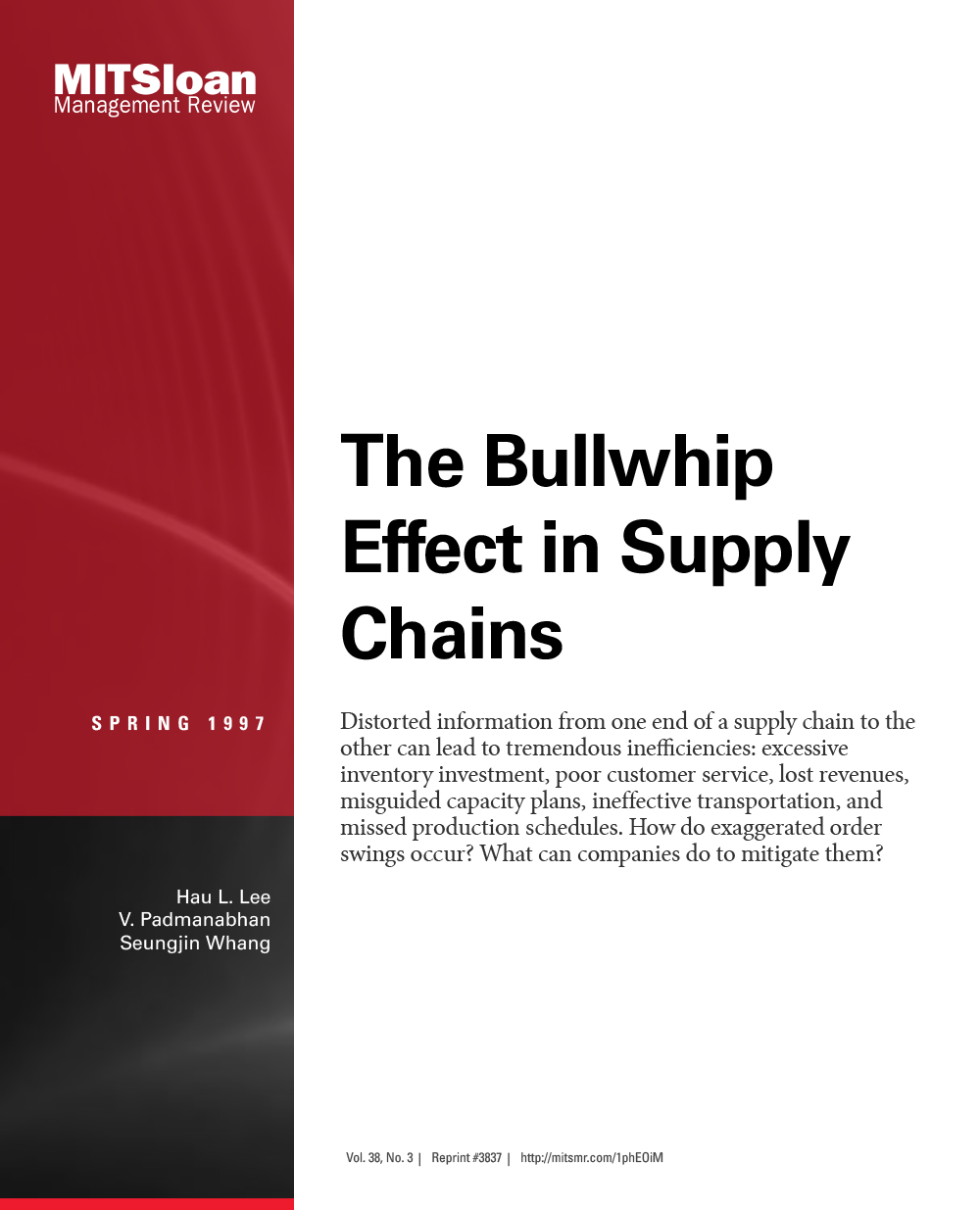
  • The Bullwhip Effect in Supply Chains

    Distorted information along a supply chain can lead to tremendous inefficiencies. How can companies mitigate them?

    Learn More »
  • Lean Production in an International Supply Chain

    In a study of lean production in a global computer company, Levy determined that the necessary flow of goods and information was costly and difficult to achieve. Managers frequently underestimated the associated costs because they did not plan for a complex, dynamic supply chain. However, some aspects of lean production such as reduction of defects and engineering change orders may facilitate globalization. In the case of CCT, a PC company, Levy compared various aspects of domestic and international sourcing. Distance was often responsible for severe delays, and the company frequently used air rather than sea freight to expedite deliveries. The expense wiped out the location's cost advantages. Managers often did not plan for the extra inventory needed to cope with fluctuating demand when the source of supply was one month away. Distance affected the accuracy of sales forecasts and impaired communications. Design-for-manufacture issues, which relied on face-to-face communication, also suffered. And production problems, which normally took a day or two to resolve with local suppliers, took almost a week with foreign suppliers. Quality control was also hampered. Levy warns companies to plan for the additional costs of operating an international supply chain. He suggests locating value chain activities close to each other, for example, in Mexico and the United States. Managers need to anticipatefrequent disruptions and see the chain as a dynamic system, with some links more critical than others.

    Learn More »
  • The Matrix of Change

    As a tool for business process reengineering, "the matrix" can help managers determine how to approach change and change management.

    Learn More »
  • Eight Imperatives for the New IT Organization

    In an overview of the future role of the IT organization, the authors examine the business and technological changes that are effecting change in many IT units. There are four major process changes in the way firms operate -- reengineering operational processes, reengineering support processes, rethinking managerial information flows, and redesigning network processes -- that all have a major impact on the IT unit. A distributed computing environment, new development software methods, capabilities like the Internet and other networks, new entrants in the computer industry, and outsourcing are the technological changes affecting the IT organization. The authors cite eight imperatives in which IT organizations must excel in order to succeed: -- Achieve two-way strategic alignment. Management and IT must work together to ensure that their initiatives are aligned. -- Develop effective relationships with line management. Communication between IT and line personnel will ensure integration of business and technology capabilities. -- Deliver and implement new systems. Systems delivery will include not only development but also procurement and integration. -- Build and manage infrastructure. IT units must develop an architecture, establish standards, communicate the value of the infrastructure, and operate the increasingly complex infrastructure. -- Reskill the IT organization. New skills -- not just technical skills but business skills -- will be needed. -- Manage vendor partnerships. IT managers must be informed buyers and negotiators. -- Build high performance. The IT unit must meet increasingly demanding performance goals. -- Redesign and manage the federal IT organization. Firms must establish the placement of IT decision-making power and the distribution of managerial responsibilities. Rockart et al. also examine the new role of IT management in ensuring that all line managers understand the potential of IT and how to use it effectively and that business strategies are effectively implemented. Success is dependent on line managers' response in planning and implementing new IT-based processes.

    Learn More »
  • Trade, FDI, and the Dollar: Explaining the U.S. Trade Deficit

    Blaine attributes the U.S. trade deficit to the declining capacity of the United States to satisfy domestic demand for manufactured products with domestic production. Every year, more Americans buy more from other countries than foreigners purchase from the United States. U.S. companies have contributed to the problem by shifting their manufacturing to companies overseas. At the same time, foreign firms are exporting more goods to the United States. Thus, says Blaine, the bulk of trade occurs between foreign units of companies rather than between independent companies located in foreign countries. According to Blaine, in his study of extensive data from a multitude of sources, multinational corporations will have a greater role in shaping international trade flows than will nations themselves. This, in turn, diminishes the efficiency of traditional macroeconomic policies. And countries like the United States that rely on the exchange rate to give firms an incentive to increase exports are less successful than countries like Japan that develop policies to give firms an incentive to increase export activities. Thus, says Blaine, changes in the value of the dollar will have only minimal effect on the trade deficit. The only way to correct the trade imbalance, then, is for U.S. firms to increase domestic production and stop satisfying U.S. demand with products made abroad.

    Learn More »
  • Returns Policies: Make Money by Making Good

    Although returns policies have been widely used for many years, they continue to be a source of controversy. The authors present a framework that explains when and how to adopt returns policies. They analyze the benefits and costs of accepting returns from distributors, and also compare returns policies to alternative ways of coordinating the distribution channel.

    Learn More »
  • The Second Toyota Paradox: How Delaying Decisions Can Make Better Cars Faster

    Although on the surface, toyota's development process seems extraordinarily cumbersome, it is a model of how to make better cars more quickly and cheaply. Toyota's engineers and managers delay decisions and give suppliers partial information, while exploring numerous prototypes. The authors examine what they call "set-based concurrent engineering," a method prevalent at Toyota but not at other Japanese and U.S. automakers. Toyota designers think about sets of design alternatives, rather than pursuing one alternative iteratively. They gradually narrow the sets until they come to a final solution. Through extensive research, case studies, and interviews, the authors present their argument - that this apparently inefficient system has made Toyota the fastest and most efficient developer of autos.

    Learn More »